
THE "AI-FREE" MOVEMENT & STICKER IS A GIMMICK...UNLESS IT ISN'T


The BBC ran a piece this week about a growing movement to label creative work "AI-Free," "Human Made," or "Proudly Human." The instinct behind it is understandable. As synthetic content floods every channel, some creators want a visible signal that something was actually made by a person—not because machines are inherently bad, but because human craft, effort, and intention still mean something to some people. Think Fair Trade for creativity.
My immediate reaction was: gimmick.
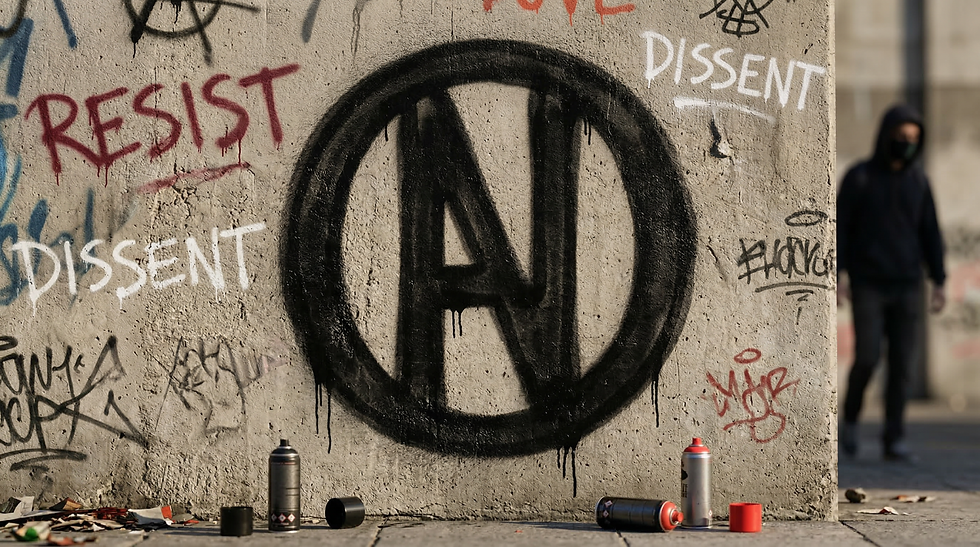
No technical enforcement mechanism. No legal backing. A visual symbol that automated scrapers ignore entirely—because scrapers aren't running vision models to check each asset for opt-out signals. They're pipeline processes operating at industrial scale, upstream of any model that could read a sticker. And even if a model could read it, the symbol could be cropped, compressed, screenshotted, or described in text. It dissolves the moment you look at it technically.
But I kept pulling on the thread. And I think there's a more interesting argument underneath—one that requires being honest about what actually happened first.
The creative history of the internet has already been mined.
Billions of pieces of human work—illustration, writing, photography, design, code, music—ingested without consent, compressed into statistical weights, and used to build commercial products generating enormous revenue. That's done. You cannot stir the milk out of the coffee. Arguing about whether historical scraping was legal is a conversation that benefits exactly one group of people, and it isn't creators.
So let's start from a different place. Let's call it what it was: a form of extraction. Work was taken, value was created from it, and the people whose work enabled that value saw nothing. The moral debt exists even if the legal framework to collect on it doesn't yet.
Now—who do you pay?
This is where the conversation usually collapses into the same objections raised against historical reparations: impossible to quantify, too many degrees of separation, who exactly is owed what? But the AI content case is structurally different in one important way. The illustrators, writers, and photographers whose work was scraped are largely alive, still working, and directly economically affected by the thing their output helped build. This isn't a debt to distant descendants. It's an active, ongoing economic injury to identifiable living people—which is actually one of the cleaner moral cases you could construct, if anyone wanted to construct it seriously.
The problem is the arithmetic doesn't work yet. OpenAI is burning cash at a rate that would be catastrophic in any conventional business model. The companies that trained on scraped work aren't profitable—the real money is sitting with hardware suppliers and infrastructure providers one layer removed from the scraping itself. You can't levy repatriation payments against losses.
But that doesn't mean the claim disappears. What it means is timing. When value crystallises—through sustained profitability, an IPO, acquisition—creators should be in the queue alongside the people who wrote cheques. Not ahead of them. Alongside them, proportionally. Not charity. Standing. You were a material contributor to what this became, even if you never agreed to be.
And there's a second route that follows its own logic: if AI companies and platforms choose to operate as genuinely free, non-profit services—no subscription revenue, no API monetisation, no profit extraction—then the moral obligation to compensate shifts. You cannot claim a commercial debt against a non-commercial enterprise. The model works the way Wikipedia works: built on human contribution, operated without extracting profit from it, and broadly accepted on that basis. Use it freely, but the moment you monetise, the terms change.
Pick one.
You're a public good or you're a commercial enterprise.
You don't get to be both.
Here's where the quantification problem gets genuinely complicated, and it matters for understanding what any compensation framework could actually look like.
A trained model doesn't contain a database of documents it queries when generating. The training data is compressed, abstracted, and dissolved into billions of weighted parameters during training. The original documents are gone in any functional sense—which is why a model can't tell you what sources it's drawing from when it generates text or images. The attribution was structurally destroyed in the process of building the thing. There is no ledger. There never was one.
This means you cannot measure influence. You cannot prove that your illustration shaped a particular output more than someone else's. The contribution was real; the evidence of it is architecturally absent.
But here's what that actually means for the framework: it flattens. If you can't measure influence, you measure ingestion. The data about what was scraped does exist—crawl logs, dataset manifests, archive records. The liability isn't "how much did your work contribute to this model's outputs." It's "your work was ingested, full stop." The payment is tiny per unit and based on quantity rather than quality. A prolific mid-tier illustrator with thousands of pieces online potentially receives more than a famous one with a small body of work. That's uncomfortable for some, but arguably more honest—the model needed the volume and variety of the long tail just as much as it needed marquee names. Possibly more.
The closest working model is mechanical royalties in music publishing: a fixed rate per unit regardless of cultural impact, because tracking differential contribution is impossible. Rough, imperfect, but it distributes without requiring attribution you can't establish.
The uncomfortable implication is that this makes the total liability almost incomprehensibly large. Billions of assets at even a fraction of a penny each adds up fast. Which is probably why nobody running these companies is volunteering to have this conversation.
Which brings us to the most pragmatic position of the three, and the one that might actually be achievable.
We cannot unwind what's been built. But we can draw a line and commit to what happens on the other side of it. Not retrospective justice—the window for that has probably passed. But a functioning ethical framework for what gets scraped and trained on from here forward. Proactive-repatriation: acknowledging the debt even if it can't be fully repaid, and ensuring the same extraction doesn't happen again without consent.
That admission matters, even without financial remedy. It moves the conversation from "was this legal?" to "we know what this was, and here's what changes." It also shifts negotiating posture. Right now AI companies argue about historical legality, which lets them avoid committing to anything about the future. A line-in-the-sand framework closes that escape route. Stop debating the past; commit to the future. If you won't, the debate about the past gets louder and the liability argument gains ground.
And this is where the sticker comes back—and where I ended up somewhere I didn't expect when I started.
Inside a proactive-repatriation framework, the "AI-Free" symbol stops being a protection mechanism and becomes something more precise: a consent signal.
It doesn't say "you can't scrape this." It says "I have not consented to this being scraped." That's a meaningful legal distinction. Without a clear, standardised signal, companies can argue ambiguity—they didn't know, the intent wasn't clear, fair use covers it. With a publicly understood marker on new work, scraping it becomes unambiguous. You knew the creator had not consented. You had the technical means to honour that signal. You chose not to.
That's not "prove my work influenced your model"—which is architecturally impossible and always will be. It's "you ignored an explicit consent signal." Cleaner liability. A much more actionable argument in court.
The technical infrastructure for this already exists in embryonic form. C2PA—the Coalition for Content Provenance and Authenticity—embeds provenance metadata into files at the point of creation, before they enter any distribution pipeline. Not a visual sticker that can be cropped away, but a verifiable chain of authorship that travels with the file. Adoption is patchy and platform support is inconsistent, but the architecture is there. What's missing is the legal obligation to honour it.
Pair a standardised consent signal with a legal framework that makes ignoring it a liability. Connect that to a living registry of contributing creators with claims that vest when profitability arrives. Require training dataset publishers to document what they ingested and whether provenance signals were present and disregarded. Build the audit trail now, before there's money on the table and the incentive to shrink the class of claimants appears.
The "AI-Free" sticker started this as a gimmick—a market signal aimed at human audiences with no technical teeth and no legal backing.
It ends up, inside the right architecture, as the visible tip of a consent infrastructure, a provenance standard, and a future liability instrument.
It just needs the architecture around it to mean anything.
And someone has to decide to build it.
Thinking out loud on this—I'm not a policy writer and I'm not selling a solution. These feel like the right questions. Where are the holes?


Comments